Avoiding Kitchen Design Mistakes: An Architectural Checklist for the Intentional Home
- Neil Norton Design

- Jun 22
- 12 min read
Updated: Jul 4
What if the most significant risk to your renovation isn't a technical miscalculation, but a failure of architectural soul? Many homeowners invest deeply in bespoke cabinetry only to find the final result feels like a disjointed collection of features rather than a singular spatial work. When the pursuit of avoiding kitchen design mistakes is reduced to a series of compromises between aesthetics and utility, the sense of tactile harmony is often the first thing lost. It is a common anxiety; the fear that a significant investment might lack the cohesive elegance you envisioned whilst failing to serve the practical rhythms of your home.
In this guide, you will discover how to transcend functional errors by adopting an architectural lens that treats the kitchen as a unified masterpiece. We will explore how refined detail, proportion, and material honesty ensure your space lasts a lifetime. You'll learn to move beyond isolated choices to embrace a language of intentionality where nothing is incidental. By the end, you will understand how to transform a room of mere function into a profound expression of authorship and craft that elevates your daily experience.
Table of Contents
Beyond the Incidental: Why Intentionality Prevents Kitchen Design Mistakes
Materiality and Proportion: Avoiding Aesthetic and Structural Incoherence
The Fallacy of the 'Standard System': Why Predefined Options Compromise Luxury
A Checklist for Refined Detail: Ensuring Precision in Layout and Flow
The Consultative Path: Transforming Your Vision into a Singular Spatial Work
Beyond the Incidental: Why Intentionality Prevents Kitchen Design Mistakes
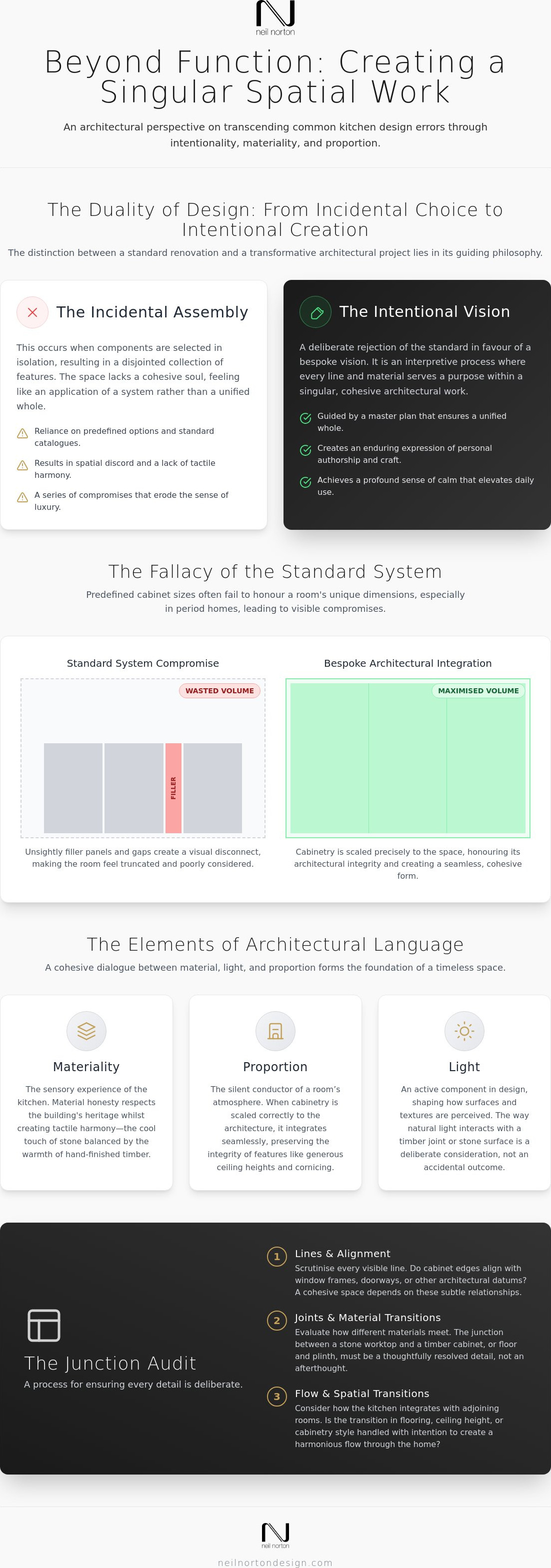
Intentional design is the deliberate rejection of predefined options in favour of a bespoke vision. It's an interpretive process where every element is chosen not because it was available in a catalogue, but because it serves a specific purpose within a singular spatial work. In many high-end renovations, homeowners fall into the trap of incidental design. This occurs when components like cabinetry, appliances, and lighting are selected in isolation. Without a cohesive master plan, these individual choices often result in spatial discord, where the room feels like a collection of parts rather than a unified whole. A fundamental step in
avoiding kitchen design mistakes
is recognising that in a truly bespoke environment, nothing is incidental.
This sense of authorship is what separates a standard renovation from a transformative architectural project. When you take ownership of the design process, the kitchen becomes a mirror of your lifestyle and values. It isn't just about where the oven sits; it's about how the transition from cooking to dining feels underfoot. It's about the way light hits a timber joint at mid-morning. By prioritising design sensitivity, you ensure the space transcends its basic utility to become an enduring expression of your personal taste and daily rituals.
The Cost of the Compromised Vision
Settling for a standard system often leads to a series of quiet compromises that erode the luxury of a home. Manufacturers of mass-produced kitchens rely on fixed unit sizes. When these units don't perfectly align with your room's dimensions, the result is wasted volume and the inclusion of unsightly filler panels. These gaps are more than just lost storage; they're evidence of a lack of craftsmanship. Whilst many designers rely on the traditional kitchen work triangle to dictate placement, an architectural approach ensures these functional zones are integrated into the home's wider flow without creating awkward junctions. An essential strategy for avoiding kitchen design mistakes is seeking professional consultation early. This serves as the antidote to expensive retrospective fixes, ensuring that the psychological impact of the space is one of calm and tactile harmony rather than frustration.
Defining Your Architectural Language
Creating a space that lasts a lifetime requires a commitment to material honesty. This means choosing textures and finishes that respect the heritage of the building whilst providing a contemporary sensory experience. Every line, joint, and transition must be deliberate from the outset to achieve a consistent palette that feels inevitable. When you move away from the "application of a system" and toward the "creation of a work," you allow the room to breathe. Architectural language is the cohesive dialogue between material, light, and proportion.
Materiality and Proportion: Avoiding Aesthetic and Structural Incoherence
Proportion is the silent conductor of a room's atmosphere. When cabinetry is scaled incorrectly, it doesn't just occupy space; it consumes the architectural integrity of the entire floor. In many London period homes, the grandeur of Victorian or Georgian architecture is defined by generous ceiling heights and intricate cornicing. A frequent error in avoiding kitchen design mistakes is installing standard-height units that stop short of the ceiling, creating a visual disconnect that makes the room feel truncated. Conversely, an ultra-modern, high-gloss kitchen inserted into a heritage shell without a transitional plan feels like an intrusion rather than an evolution. True design sensitivity requires an architectural language that respects the original shell whilst introducing a contemporary expression of authorship.
Materiality extends far beyond a simple colour palette. It's the sensory experience of the kitchen; the cool touch of a stone island, the warmth of a hand-finished timber joint, and the weight of a solid brass handle. Tactile harmony is lost when materials are chosen in isolation. A space feels disjointed when the "visual weight" of a heavy marble splashback isn't balanced by the grounding presence of substantial cabinetry or thoughtful flooring. Every surface must engage in a deliberate dialogue with its neighbour to create a singular spatial work.
The Error of Misjudged Scale
The kitchen island is often the primary victim of misjudged scale. Whilst a large central feature is desirable, an oversized island can stifle the spatial rhythm of the room, turning fluid movement into a series of awkward manoeuvres. Proportion must be interpretive. This means maximising vertical volume with bespoke cabinetry that draws the eye upward, celebrating the room's height. Balancing the visual weight of stone, timber, and metal elements ensures that no single component overwhelms the delicate architectural balance of the home. The pursuit of such balance is why many homeowners seek bespoke cabinetry solutions that respect the home's original footprint.
Honouring Material Honesty
Material honesty is the rejection of the superficial. Imitation materials, such as laminate "wood" or printed "stone," often fail to provide the enduring quality found in a true bespoke kitchen design. These substitutes lack the depth and soul of natural substances and rarely age with grace. A successful renovation avoids the "showroom effect," where a space looks impressive under bright lights but feels cold, fragile, or impersonal during daily use. By selecting authentic finishes that develop a gentle patina over time, you ensure your kitchen doesn't just look exquisite today but continues to feel like a home that lasts a lifetime. In the process of avoiding kitchen design mistakes, remember that the most beautiful spaces are those where every joint and transition feels inevitable and honest.
The Fallacy of the 'Standard System': Why Predefined Options Compromise Luxury
A frequent error in the pursuit of a high-end home is viewing the kitchen as a collection of modular boxes rather than a singular spatial work. Most retailers operate on the "application of a system," where predefined unit sizes dictate the layout of your room. This approach forces the architecture of your home to compromise for the sake of the furniture. In contrast, an intentional design process treats the kitchen as an interpretive piece of architecture. By avoiding kitchen design mistakes rooted in rigid standardisation, you allow the cabinetry to be designed to the millimetre, honouring the unique junctions and nuances of your home’s footprint.
When you move beyond the one-size-fits-all trap, the kitchen begins to reflect a true sense of authorship. This level of precision is the cornerstone of luxury kitchen design. It ensures that every line and transition is deliberate, creating a sense of permanence that mass-produced systems simply cannot replicate. In a bespoke environment, the furniture doesn't just sit in the room; it belongs to the room.
The Myth of the Perfect Triangle
The traditional kitchen work triangle is often cited as the gold standard of layout planning, yet in modern, multifunctional spaces, it can be a restrictive mistake. This geometric rule was established in an era when kitchens were isolated workshops for a single cook. Today’s intentional home requires a more sophisticated approach. We design for "zones of activity" that allow for multiple users, social interaction, and varied culinary tasks to occur simultaneously. Prioritising spatial flow ensures that your kitchen remains a functional workshop whilst serving as a graceful setting for entertaining. It is about creating a rhythm of movement that feels natural rather than dictated by an outdated formula.
The Hidden Danger of Filler Panels
Filler panels are the quiet betrayals of a standard kitchen system. These strips of material are used to mask the incidental gaps left when stock cabinetry fails to meet the wall or ceiling. They represent wasted volume and a lack of craftsmanship. In a bespoke project, these gaps are eliminated through precise manufacturing. Every corner is treated as an opportunity for intentional storage, ensuring that the cabinetry utilises the full potential of the room. This commitment to refined detail results in seamless transitions from floor to ceiling, providing a visual superiority that elevates the entire architectural language of the home. By avoiding kitchen design mistakes like the use of fillers, you achieve a level of tactile harmony where every joint is purposeful and every surface is flush.
A Checklist for Refined Detail: Ensuring Precision in Layout and Flow
To move beyond a simple renovation and toward the creation of a singular spatial work, one must master the nuances of the Junction Audit. This process ensures that every line, joint, and transition is deliberate and documented well before installation begins. A frequent pitfall in avoiding kitchen design mistakes is treating technical components as afterthoughts. In an intentional home, the layout is an interpretive dialogue between the existing architecture and the user's daily rituals. This requires a rigorous Spatial Rhythm Test. You must ask whether the flow feels natural or if there are subtle choke points around the island that will disrupt the room’s quiet elegance during use. When appliances are treated as interpretive elements rather than mere machines, they become part of a cohesive whole where nothing is incidental.
The Precision of Junctions and Joints
The pursuit of refined detail is most evident where different materials meet. In London period homes, the intersection of bespoke cabinetry and historic features like ornate cornicing or deep skirting requires immense design sensitivity. It isn't enough for furniture to sit near these elements; it must interact with them. A perfect joint is one where the transition between stone and timber feels inevitable rather than forced. This level of precision ensures that the architectural language of the home is respected and enhanced. If you are ready to transform your home through meticulous craft, book a consultation with our design team to discuss your vision.
Lighting as an Architectural Tool
Lighting should never be reduced to a utilitarian grid of spotlights that flattens the room’s materiality. Instead, it should function as an architectural tool that defines the space’s sensory experience. By integrating task, mood, and architectural lighting, you can transcend function and create a room that shifts its character from day to night. Use shadows and highlights to emphasise the tactile harmony of bespoke surfaces and the material honesty of hand-finished timber. When lighting is integrated directly into the cabinetry, it elevates daily use into a quiet, sensory ritual. This approach ensures that avoiding kitchen design mistakes extends to the very atmosphere of the room, highlighting the pursuit of refined detail in every corner.
The Consultative Path: Transforming Your Vision into a Singular Spatial Work
The final stage of creating an intentional home involves moving from the abstract to the tangible through a personal and artistic approach to planning. Whilst the technical checklists provided in previous sections are essential for avoiding kitchen design mistakes, they are most effective when applied through the lens of professional expertise. A consultation is the bridge between simply acquiring a new kitchen and creating a profound expression of authorship. It is during these interpretive sessions that the latent potential of a London property is truly uncovered, allowing the homeowner to move beyond the limitations of standard systems and embrace a singular spatial work that respects the building's heritage.
At Neil Norton Design, we believe that the planning phase should be as refined as the craftsmanship itself. This process isn't a mere checklist of appliances and finishes. It is a deep exploration of materiality, light, and proportion. By engaging in a consultative dialogue, you ensure that the spatial rhythm of your home is enhanced rather than interrupted. This methodology prioritises the sensory experience of the space, ensuring that tactile harmony is achieved in every joint and transition. Ultimately, avoiding kitchen design mistakes is about choosing a partner who understands that every line is a commitment to your long-term satisfaction.
The Role of the Expert Consultant
Expert consultants bring more than just technical knowledge; they possess the quiet confidence required to navigate the complexities of London residential interiors. Every project presents unique architectural challenges, from the structural nuances of period properties to the delicate integration of modern lighting layers. By translating your lifestyle requirements into a cohesive architectural language, a designer reduces the friction of the renovation process. This intentional planning ensures that the final result is not a compromise, but a deliberate realisation of your vision. We act as trusted advisors, guiding you through the pursuit of refined detail whilst maintaining a steady focus on the project’s artistic integrity.
Commencing Your Design Journey
Your design journey begins with an invitation to our studios in Wimbledon or London. Here, we move from initial inspiration to the creation of a singular spatial work through a series of interpretive design stages. We believe that a bespoke kitchen is not merely a purchase; it is an enduring investment in your lifestyle and the heritage of your home. By choosing a path of craftsmanship and design sensitivity, you ensure that your environment transcends function to become a classic work that lasts a lifetime. We invite you to transform your home with an approach that celebrates material honesty and the permanent value of tailored design.
Realising Your Singular Spatial Work
Creating a kitchen that transcends mere function requires a fundamental shift from selecting systems to authoring a singular spatial work. By prioritising materiality, proportion, and the precision of every joint, you move beyond the limitations of predefined options. The path to avoiding kitchen design mistakes lies in this commitment to architectural language and refined detail. It ensures your home reflects a cohesive vision where every transition is deliberate and every surface possesses material honesty. This design sensitivity is what allows a room to breathe and age gracefully whilst serving the practical needs of your lifestyle.
As an award-winning bespoke studio based in Wimbledon, Neil Norton Design has helped over 200 happy clients across London and Ireland transform their living spaces into expressions of personal authorship. Our philosophy is rooted in the promise of classic design that lasts a lifetime. We invite you to move beyond the incidental and embrace a home that is truly intentional. Begin your journey toward an intentional home with a Professional Design Consultation and discover the quiet confidence that comes with expert craftsmanship. Your vision deserves an environment that is as enduring as it is beautiful.
Frequently Asked Questions
What is the most common mistake in bespoke kitchen design?
The most frequent error is the accumulation of incidental choices rather than the execution of a singular, intentional vision. Many homeowners select high-end components in isolation, which leads to a disjointed aesthetic where the cabinetry fails to harmonise with the room's architectural language. True luxury requires a cohesive plan where every joint and transition is deliberate from the very first sketch.
How do I avoid a kitchen layout that feels cramped in a small London flat?
You can avoid a cramped feeling by prioritising vertical proportion and bespoke volumes that utilise every millimetre of ceiling height. In constrained London flats, avoiding kitchen design mistakes often means rejecting oversized islands that stifle spatial rhythm. Instead, focus on tailored cabinetry that maximises light and flow whilst respecting the home's original footprint and architectural integrity.
Why is materiality more important than colour in a luxury kitchen?
Materiality defines the sensory and intellectual experience of a space, whereas colour is merely a superficial layer. A luxury kitchen relies on tactile harmony and material honesty, such as the cool touch of natural stone or the warmth of hand-finished timber. These authentic textures provide a sense of permanence and depth that transcends fleeting colour trends, ensuring the room remains an enduring work of art.
Can I avoid kitchen design mistakes by following current trends?
Following current trends is often the quickest route to a dated interior that lacks character. To truly transcend function, you should focus on a personal expression of authorship and classic design principles that respect the heritage of your home. By avoiding kitchen design mistakes rooted in fleeting fashions, you ensure your investment remains relevant and beautiful for a lifetime rather than just a season.
How does professional consultation prevent expensive renovation errors?
Professional consultation bridges the gap between a standard renovation and a singular spatial work by identifying technical challenges before they become costly retrospective fixes. An expert designer uses intentional planning to ensure that cabinetry junctions, lighting layers, and spatial flow are perfectly aligned with your lifestyle. This interpretive process reduces the friction of renovation and guarantees a level of precision that stock systems cannot match.
What should I consider when integrating appliances into bespoke cabinetry?
When integrating appliances, you must treat them as interpretive elements within the wider architectural whole rather than mere afterthoughts. This involves ensuring that technical components are flush with bespoke cabinetry and that every line remains clean. You must also consider the hidden requirements of ventilation and power, ensuring they are integrated with design sensitivity so they don't disrupt the room's visual superiority.
How can I ensure my kitchen design remains timeless amongst changing fashions?
Timelessness is achieved through a commitment to material honesty and the pursuit of refined detail. By rejecting predefined options in favour of bespoke solutions that respect the room's unique proportions, you create a space that feels inevitable. Focus on quality craftsmanship and finishes that age with grace, as these elements remain elegant and intellectually satisfying amongst changing fashions for decades.
What is the difference between a "fitted kitchen" and a "bespoke spatial work"?
A fitted kitchen is usually an application of a standardised system that relies on stock sizes and unsightly filler panels to mask gaps. In contrast, a bespoke spatial work is an interpretive creation designed to the millimetre. It honours the room's unique junctions and nuances, ensuring that every transition is purposeful and that the furniture belongs to the architecture of the home.


Comments