What to expect from a luxury kitchen design consultation

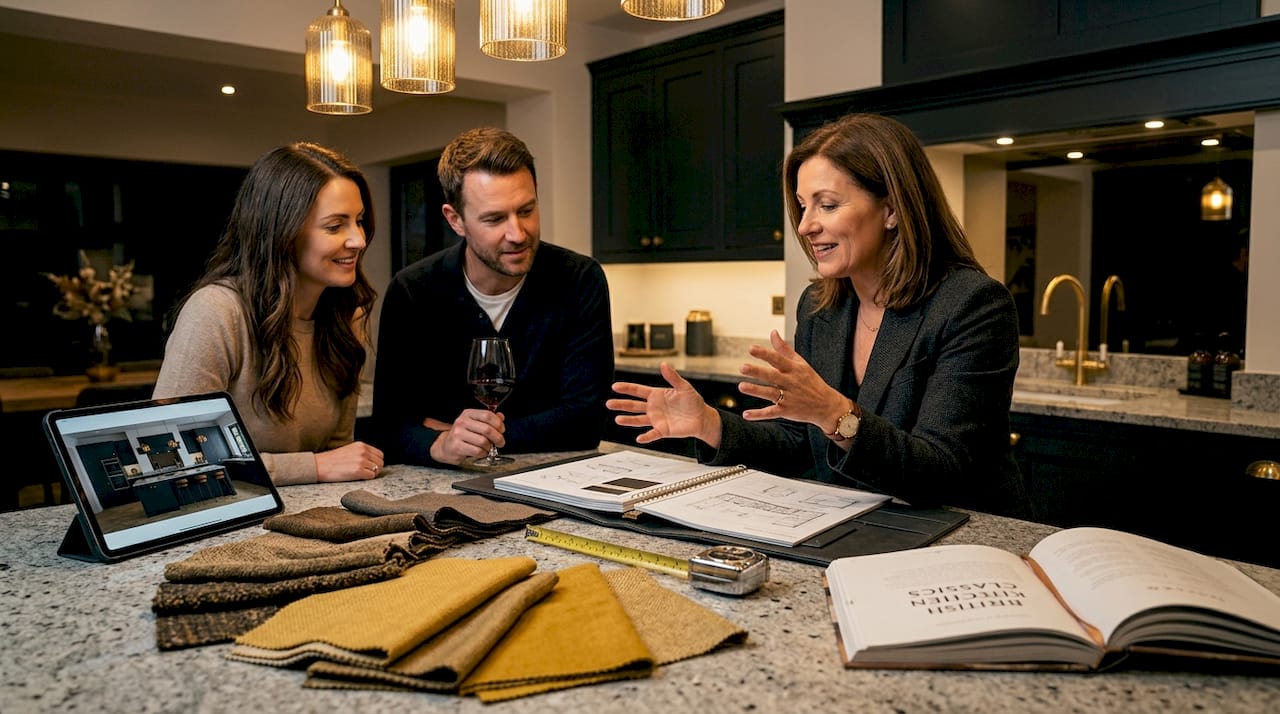
Most people assume a kitchen design consultation is simply a chance to browse finishes, flick through a portfolio, and pick a cabinet colour. In reality, it is the single most important conversation you will have before committing to a significant investment in your home or development project. A well-structured consultation shapes every decision that follows, from structural feasibility to the precise placement of an island. For affluent homeowners and property developers in London and Ireland, understanding what this process genuinely involves can mean the difference between a kitchen that merely looks impressive and one that performs beautifully for decades.
Table of Contents
Key Takeaways
Point | Details |
Consultation defines vision | A kitchen design consultation clarifies lifestyle and property needs before plans or purchases begin. |
Site surveys are essential | On-site assessments check for structure, plumbing, and layout issues, preventing costly surprises. |
Custom paths for each client | Developers and homeowners benefit from tailored solutions and can choose design-only or full build options. |
Regulations drive decisions | Compliance with UK/Ireland regulations shapes layouts and technical planning from the start. |
What is a kitchen design consultation?
Let’s begin by unpacking what a kitchen design consultation truly involves and why it matters for your bespoke space.
A consultation is, at its core, a discovery process. It is not a sales presentation. It is a structured dialogue in which your designer works to understand your property, your lifestyle, and your long-term expectations before a single line is drawn. The best consultations feel more like a thoughtful conversation than a formal meeting, and that is entirely intentional.
During this initial stage, a skilled designer will explore several interconnected areas:
Your vision and aesthetic priorities: What atmosphere do you want the kitchen to create? Warm and sociable, or calm and refined?
How you actually use the space: Do you cook professionally, entertain frequently, or need a family-friendly layout that withstands daily life?
The property context: Is this a period townhouse in Kensington, a contemporary new-build in Dublin, or a high-spec development in Mayfair?
Practical constraints: Ceiling heights, natural light, existing plumbing runs, structural walls, and floor conditions all influence what is possible.
Budget parameters and timeline: Understanding these early prevents misalignment later in the process.
As kitchen layout renovation specialists note, a consultation lays the groundwork for the layout and considers function and site conditions, ensuring that every design decision is grounded in reality rather than aspiration alone. For those pursuing luxury bespoke kitchen design, this foundation is non-negotiable.
The value of this stage cannot be overstated. Decisions made in the first consultation, such as where to position the cooking zone or whether to open a wall, will cascade through every subsequent phase. Getting them right from the outset protects your investment and prevents costly revisions down the line.
Step-by-step: The consultation process explained
Now that you know what a consultation covers, let’s break down the process step by step so you know exactly what to expect.
A professional kitchen design consultation for a luxury project typically follows a clear sequence, even if the conversation itself feels fluid and exploratory.
Initial vision discussion: Your designer listens carefully to your brief, asks probing questions about how you live, and begins to understand the emotional as well as functional requirements of the space.
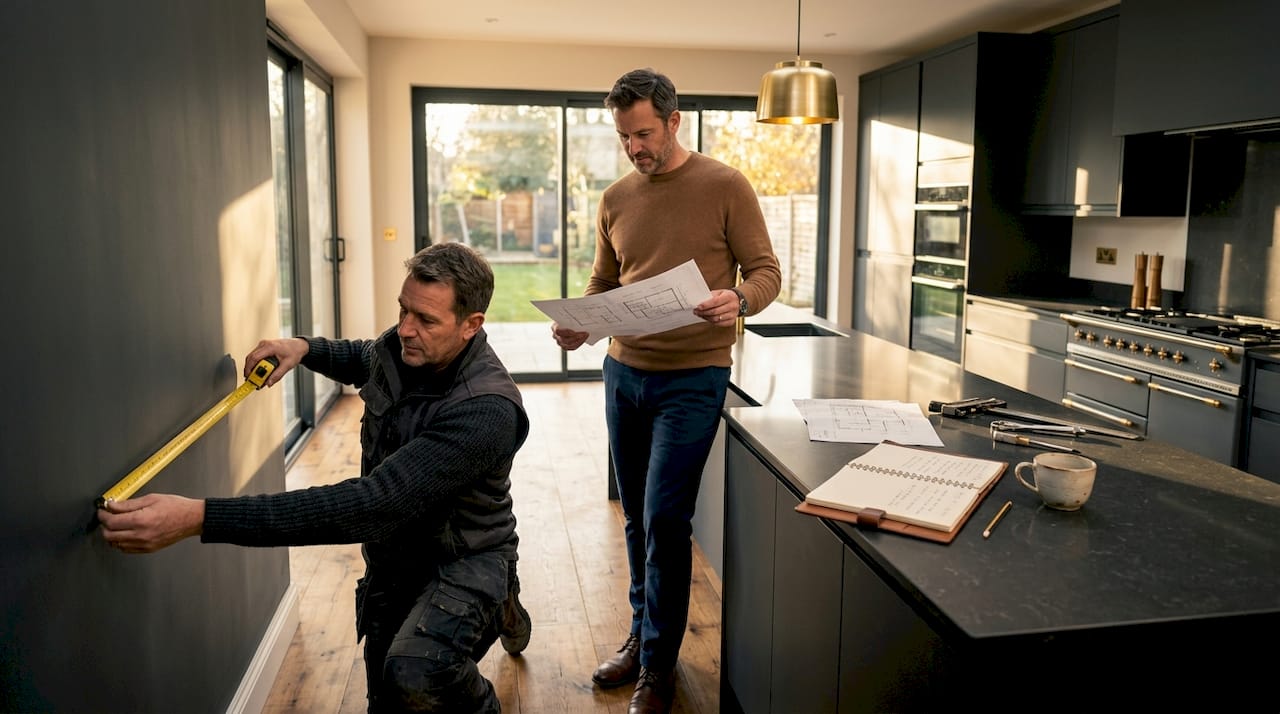
Site survey and assessment: This is where the technical groundwork begins. Measurements are taken, structural elements are noted, and the condition of existing plumbing and electrical infrastructure is assessed. Site surveys for kitchen projects are essential because floor variations and plumbing positions directly influence layout options.
Layout prioritisation: Based on the survey findings, your designer will begin identifying which layouts are structurally viable and which best serve your lifestyle. The classic work triangle, island configurations, and galley formats are all evaluated against your specific space.
Material, finish, and appliance consideration: At this stage, the conversation shifts towards the tactile and visual. Timber species, lacquer finishes, stone worktops, integrated appliances, and hardware are discussed in the context of your overall interior scheme.
Defining the next steps: The consultation concludes with clarity on whether you are pursuing a design-only service, a full design-and-build partnership, or something in between. Your designer will outline the kitchen design process and what deliverables you can expect at each stage.
Consultation stage | Key focus | Typical duration |
Vision and brief | Lifestyle, goals, aesthetic direction | 20 to 30 minutes |
Site survey | Measurements, structural review, services | 20 to 40 minutes |
Layout and function | Spatial planning, workflow, zoning | 15 to 25 minutes |
Materials and finishes | Surfaces, hardware, appliances | 15 to 20 minutes |
Next steps and scope | Service model, timeline, budget | 10 to 15 minutes |
Site surveys address vital practical issues like floor variations and plumbing, which is why this stage deserves as much attention as the more glamorous conversations about marble and cabinetry.
Pro Tip: Before your consultation, photograph every wall and corner of the existing kitchen, including inside cupboards and behind appliances. This visual record helps your designer spot constraints that are easy to miss during a first visit.
Tailoring solutions: Bespoke needs for developers vs. homeowners
Consultations are not one-size-fits-all. Let’s compare how the process plays out differently for developers and private homeowners.
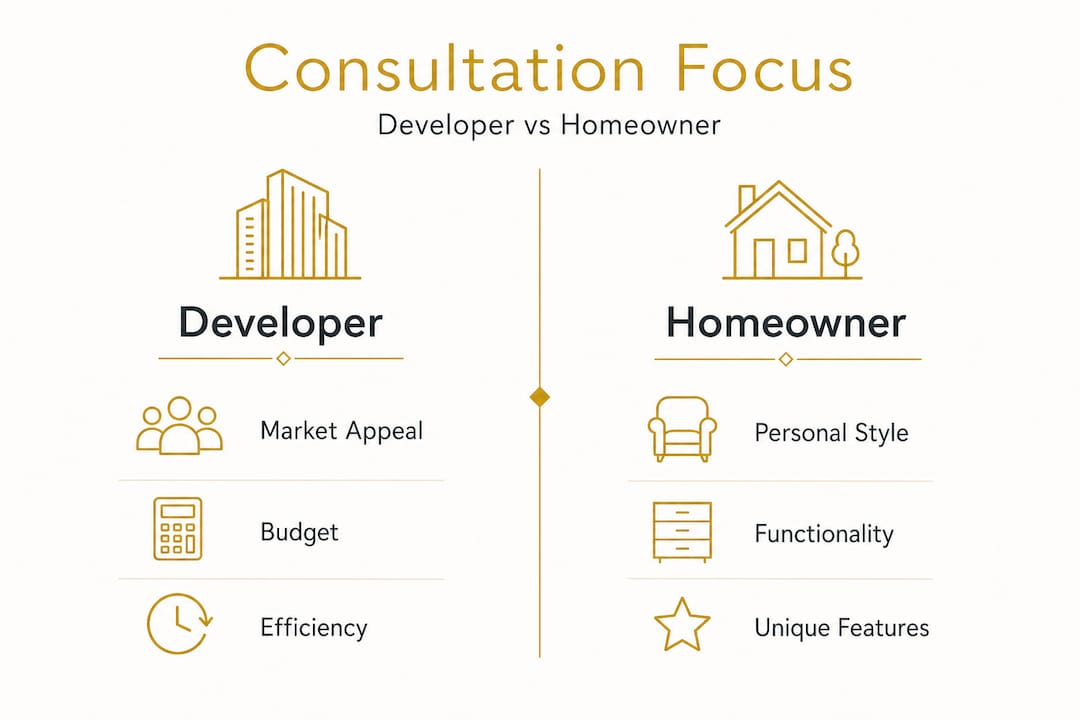
The priorities that drive a private homeowner are deeply personal. They want a kitchen that reflects their taste, supports their daily rituals, and adds genuine joy to their home. The brief is often rich with references, inspiration images, and specific functional wishes, such as a concealed larder, a dedicated wine storage zone, or a bespoke island designed for a particular style of entertaining.
Property developers, by contrast, are working to a different set of imperatives. Their decisions are shaped by target buyer profiles, development timelines, and the need to deliver consistent quality across multiple units or properties. The kitchen must appeal broadly while still feeling premium and considered.
Factor | Private homeowner | Property developer |
Design driver | Personal lifestyle and taste | Market appeal and value uplift |
Timeline | Flexible, quality-led | Often fixed to completion schedules |
Customisation level | Highly individual | Scalable with premium finishes |
Budget approach | Investment in personal vision | Return on investment focused |
Key concern | Emotional resonance | Specification consistency |
For homeowners, the consultation is an opportunity to articulate a vision that may have been building for years. For developers, it is a strategic conversation about how a kitchen specification can differentiate a property in a competitive market. Both deserve the same depth of expertise and attention.
Independent designers offer a distinct advantage in both scenarios. Unlike tied suppliers who can only specify from their own range, an independent studio brings genuine flexibility. Developer kitchen solutions benefit enormously from this freedom, as it allows the specification to be built around performance and aesthetics rather than catalogue limitations.
Key advantages of working with an independent bespoke designer include:
Unrestricted material and supplier access, allowing the best choice for each project rather than the available choice
Seamless integration with existing building teams, architects, and interior designers
Tailored briefs for each client type, whether a single private residence or a multi-unit development
Long-term relationships that evolve as your portfolio or home grows
Independent vs tied suppliers and non-gut refresh options offer unique value for different clients, which is precisely why the consultation must be structured around your specific context rather than a generic template.
Hidden complexities: Regulations, construction, and beyond
Beyond the immediate design experience, bespoke kitchens require coordination with regulations and construction realities. Here is what you need to know.
One of the most significant things a thorough consultation reveals is the complexity that lies beneath the surface of any kitchen project. This is especially true in London and Ireland, where period properties, listed buildings, and strict planning regulations add layers of consideration that simply do not exist in a standard new-build.
Overcoming kitchen renovation challenges in these contexts demands a designer who understands not just aesthetics, but the technical and regulatory landscape as well.
Key considerations that a professional consultation will address include:
Structural integrity: Are the existing walls and floors capable of supporting new loads, particularly for heavy stone worktops or large island structures?
Plumbing and drainage: Relocating a sink or adding a kitchen island with a tap requires careful assessment of existing pipe runs and fall gradients.
Electrical compliance: High-specification kitchens with integrated appliances, under-cabinet lighting, and smart home systems require a compliant and carefully planned electrical scheme.
Listed building and conservation area constraints: In many parts of London and Dublin, alterations to kitchens in period properties require consent, and certain materials or configurations may be restricted.
Ventilation requirements: Extraction systems in high-use kitchens must meet specific performance standards, particularly in apartments or properties with limited external wall access.
“Complying with structural and building regulations is a core part of kitchen layout planning, not an afterthought.”
Structural and building regulations compliance in the UK and Ireland is a core part of kitchen layout planning, and a designer who raises these issues early is protecting your project from expensive surprises.
Pro Tip: If your property is listed or sits within a conservation area, ask your designer about their experience with consent applications before committing to any layout changes. This expertise is rare and genuinely valuable.
It is also worth noting that not every kitchen project requires a full gut renovation. If the existing layout is fundamentally sound, a skilled designer may recommend a non-gut refresh that updates finishes, appliances, and cabinetry without disturbing the structural fabric of the space. This approach can deliver a transformative result at a fraction of the cost and disruption of a full renovation.
From consultation to completion: How to maximise your outcome
Armed with this context, here is how you can take action to ensure your kitchen consultation leads to a project that exceeds expectations.
Preparation is the single greatest gift you can give yourself before a consultation. The more clearly you can articulate your needs, the more efficiently your designer can translate them into a design brief.
Gather your property documents: Floor plans, architectural drawings, and any existing planning permissions are invaluable reference points for your designer.
Compile inspiration references: A curated selection of images, whether from design publications, social media, or previous projects you admire, communicates aesthetic intent far more efficiently than words alone.
List your non-negotiables: Identify the appliances, features, and functional requirements that are truly essential. A range cooker, a dedicated coffee station, a walk-in larder. Be specific.
Note what frustrates you about your current kitchen: The things that do not work in your existing space are just as informative as the things you love.
Prepare your questions: Ask about the design timeline, the number of revisions included, how the designer coordinates with your building contractor, and what happens if structural issues are discovered mid-project.
Be honest about budget: A bespoke designer works most effectively when they understand the full picture. Transparency here leads to better outcomes for everyone.
Examples of successful kitchen projects demonstrate consistently that the most satisfying results come from clients who engaged deeply with the consultation process rather than treating it as a formality. A thorough consultation up front prevents issues and enables non-gut refreshes if the existing layout works, saving both time and money without compromising on quality.
Our perspective: The crucial edge in luxury kitchen consultations
With all these insights in hand, it is worth sharing what we have learned from guiding luxury projects at the highest level.
After more than 25 years of designing bespoke kitchens for some of the most discerning clients in London and Ireland, we have observed a consistent pattern. The projects that deliver the greatest satisfaction, and the greatest long-term value, are almost always the ones where the consultation was treated as a genuine creative and technical partnership rather than a box to tick.
What developers and affluent homeowners most commonly overlook is the cumulative value of early decisions. Choosing to open a wall, reposition an island, or invest in a specific material is not simply an aesthetic choice. It is a structural, regulatory, and financial commitment that will shape the project for months and the home for decades.
We have seen projects where a client bypassed a thorough consultation in favour of speed, only to discover mid-build that a planned layout conflicted with a load-bearing wall, or that a chosen finish was incompatible with the property’s listed status. The cost of correcting these issues invariably exceeds the cost of the consultation itself, often many times over.
The hidden value of working with a specialist from the outset lies in what does not go wrong. A designer who understands our approach to kitchen design brings not just creativity but a structured methodology that anticipates problems before they arise. That quiet confidence, the knowledge that every decision has been considered from multiple angles, is what truly distinguishes a bespoke consultation from a generic one.
Generic layouts and missed building regulations are the two most common pain points we hear from clients who have worked with less specialist providers. Both are entirely preventable with the right expertise in the room from day one.
Transform your project with a bespoke kitchen consultation
If you are ready to realise the full potential of your property’s signature space, here is how to move forward with confidence.
At Neil Norton Design, every project begins with a conversation. We take the time to understand your vision, your property, and your ambitions before we put pencil to paper. Our consultations are structured to give you clarity, confidence, and a clear path forward, whether you are planning a single private kitchen or specifying across a luxury development.
Our portfolio of bespoke kitchens reflects the breadth and depth of what is possible when craftsmanship meets a truly personalised brief. From contemporary handleless designs to richly detailed traditional cabinetry, every kitchen we create is built around the people who will use it. Explore our full range of kitchen design services and take the first step towards a kitchen that is genuinely, unmistakably yours. Book your free design consultation today and let us show you what bespoke truly means.
Frequently asked questions
How long does a luxury kitchen design consultation typically take?
A bespoke kitchen design consultation usually lasts between 60 and 120 minutes, depending on the complexity and scope of the project. Larger or more technically involved spaces, such as open-plan extensions or listed properties, may require additional time.
Can a consultation help refresh my kitchen without a full renovation?
Yes, if the current layout is functional, non-gut refreshes may be recommended after a thorough assessment during the consultation. This approach can deliver a striking transformation without the disruption or cost of a full structural renovation.
Do I need to prepare anything in advance for a kitchen consultation?
Bringing property plans, inspiration images, and a list of must-have appliances helps your designer understand your vision quickly and accurately. A note of what frustrates you about your existing kitchen is equally useful.
Will my bespoke kitchen consultation cover building regulations?
Yes, compliance with structural and local regulations is reviewed as part of the layout and planning process, particularly for period properties and listed buildings in London and Ireland.
Can I choose between design-only and full build services?
You may opt for design-only or comprehensive design-build options depending on your project needs and existing contractor relationships. Your designer will help you identify which approach best suits your timeline and ambitions.
Recommended


Comments