How to Brief a Joiner for Bespoke Furniture: An Architectural Approach
- Neil Norton Design

- 23 hours ago
- 12 min read
A truly bespoke piece of furniture is far more than a functional object; it is a permanent architectural intervention that defines the tactile harmony of a room. You likely understand the transformative power of a custom wardrobe or a bespoke kitchen, yet the challenge often lies in translating a refined mental vision into a physical reality. The fear that a lack of technical vocabulary might result in clashing materials or awkward proportions is a common hurdle for those seeking a singular spatial work. Understanding how to brief a joiner for bespoke furniture is the essential bridge between your creative intent and the artisan's precision.
We agree that your home deserves an expression of authorship that transcends mere utility. You'll learn to articulate a sophisticated design vision that ensures every line, joint, and surface transition feels entirely deliberate. This guide provides a clear roadmap for communication that builds your confidence in materiality, material honesty, and defining proportions. It's time to move beyond standard dimensions and embrace an interpretive architectural narrative where nothing is incidental and every detail is intentional.
Table of Contents
Defining the Architectural Intent: Beyond the Functional Checklist
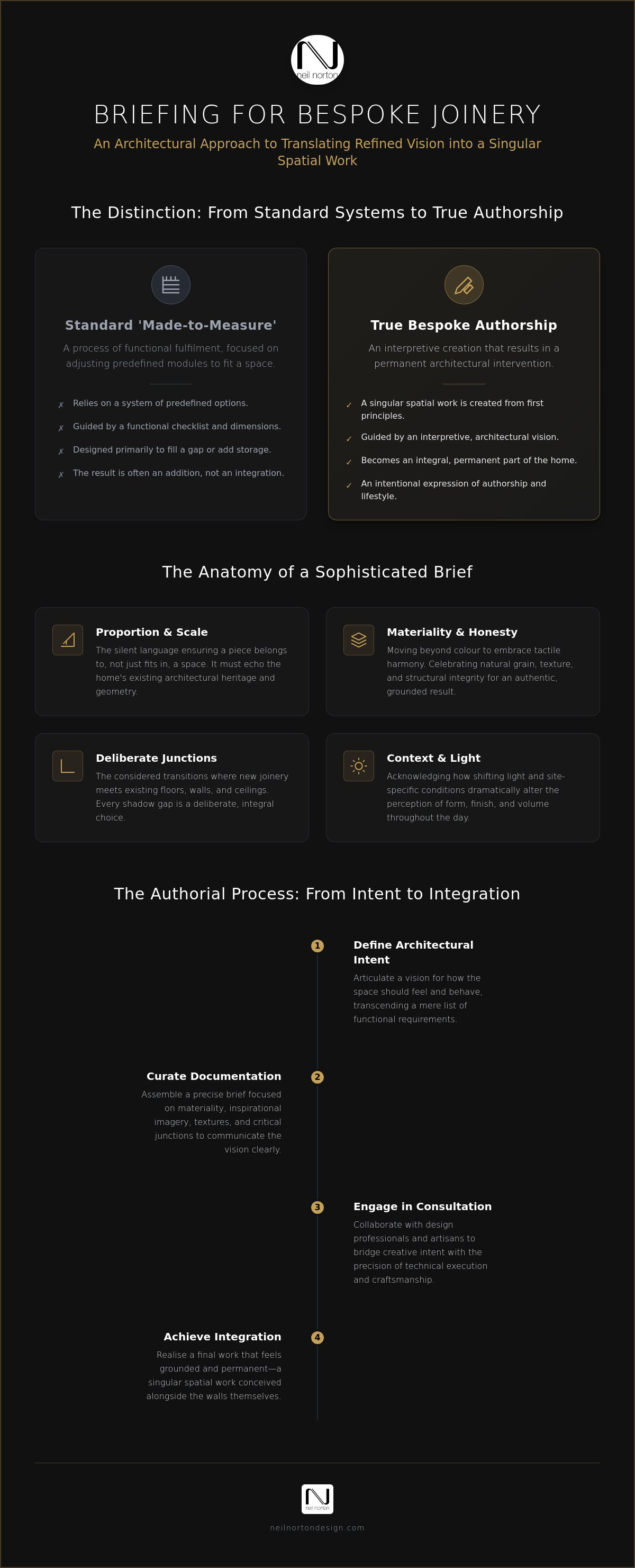
A successful commission begins long before the first timber is cut. It starts with the realisation that a brief is not merely a list of measurements or a functional checklist. Instead, it is an interpretive document that outlines a vision for how a space should feel and behave. When considering how to brief a joiner for bespoke furniture, one must look past the immediate utility of the object. The craft of joinery is an ancient discipline that, in its highest form, becomes a permanent architectural intervention. It's the essential difference between "made-to-measure" systems, which often rely on predefined modules adjusted to fit a gap, and true bespoke authorship. The latter involves the creation of a singular spatial work that respects the unique geometry of your home.
Material honesty is central to this architectural approach. It's the practice of allowing materials to be themselves rather than imitating something else. A sophisticated brief should specify how grain patterns, natural textures, and structural elements are celebrated. This sensitivity ensures that daily use is quietly elevated. A wardrobe or a bespoke kitchen shouldn't just store items; it should facilitate a sense of pride and security through its enduring quality and tactile harmony. By focusing on materiality and proportion, you ensure the piece feels grounded within its context rather than appearing as an afterthought.
Establishing the Architectural Language
A piece of furniture must respond to the existing lines and transitions of the room to feel truly integrated. This requires a focus on deliberate junctions where the joinery meets the floor, walls, or ceiling. If a cabinet sits against a period cornice, the transition must be handled with design sensitivity. Mastering how to brief a joiner for bespoke furniture involves articulating these deliberate choices. Nothing in a bespoke brief should be incidental. Every shadow gap, handle placement, and plinth height is a choice that contributes to a cohesive whole.
The Philosophy of Bespoke Authorship
Choosing bespoke joinery is a rejection of predefined options in favour of a tailored solution that lasts a lifetime. It's a shift in perspective from buying furniture to curating an environment. You aren't just filling a room; you're commissioning an intentional expression of your lifestyle. This process ensures that the finished piece is not a standalone object but a component of a singular spatial work. Every line and joint becomes a deliberate part of your home's narrative. Ultimately, bespoke joinery is an intentional expression of the homeowner’s lifestyle that transforms the rhythm of daily life.
The Anatomy of a Sophisticated Brief: Proportion and Materiality
A sophisticated brief is an exercise in restraint and precision. It requires moving beyond simple colour palettes to embrace the broader concept of materiality. When you consider how to brief a joiner for bespoke furniture, you must evaluate how textures, weights, and finishes create a sense of tactile harmony within the existing architecture. This is particularly vital in London residences, where the unique, often shifting light conditions can dramatically alter the appearance of various wood species and lacquers throughout the day. A deep walnut that feels rich in a sun-drenched morning room might appear overly heavy in a north-facing study unless the proportions are adjusted with design sensitivity.
Proportion is the silent language that ensures a piece feels grounded. It isn't just about fitting into a space; it's about belonging to it. A bespoke kitchen or a home office should reflect the heritage of the building, echoing the heights of skirting boards or the depth of window reveals. This alignment creates a sense of permanence, as if the furniture was conceived alongside the walls themselves. Achieving this level of integration requires a framework for discussing materiality that moves beyond the superficial, focusing instead on how the piece interacts with the room's volume.
Mastering Scale and Spatial Proportion
Deciding whether a piece should be a commanding focal point or a quiet architectural element is the first step in the pursuit of refined detail. For bespoke wardrobes or alcove units, the use of negative space is as critical as the timber itself. Leaving room for the eye to rest prevents a singular spatial work from overwhelming the room. The silhouette must be deliberate, ensuring that every transition between the furniture and the void is intentional. This careful management of scale ensures the result feels like a natural extension of the home’s layout.
Selecting a Cohesive Material Palette
High-end joinery often transcends timber to incorporate metal, stone, or glass, providing the tactile contrast that defines modern luxury. Selecting a material palette requires a deep understanding of grain direction and veneer matching as structural design choices rather than mere finishing touches. Book-matching or slip-matching veneers can transform a flat surface into a rhythmic, moving landscape of natural beauty. This level of material honesty ensures a classic design that lasts a lifetime. If you are ready to explore these possibilities, you might find inspiration in the bespoke collections crafted by our specialist team. Understanding how to brief a joiner for bespoke furniture with this level of detail ensures that your material choices reflect a commitment to both beauty and longevity.
Navigating the Intersection of Form and Daily Utility
True design sensitivity ensures that a piece of furniture is never a static monument. It is a living component of your home that facilitates the rhythm of your life. When you explore how to brief a joiner for bespoke furniture, you must consider how environments transcend their primary function to become an expression of authorship through daily use. Every interaction with a surface or a handle should feel intentional. A common misconception is that high-end bespoke design is too precious for the rigours of everyday life. In reality, the opposite is true. Precision craftsmanship and material honesty provide a level of durability that mass-produced systems cannot match. Refined details like integrated internal lighting or calibrated soft-close mechanisms don't just add luxury. They provide a sensory cue that your environment is working in harmony with your needs.
Understanding how to brief a joiner for bespoke furniture involves a deep analysis of these micro-interactions. It's about ensuring that the pursuit of refined detail doesn't stop at the exterior. When a piece is designed with an architectural approach, its utility is quietly elevated. The transition from a closed cabinet to an open workspace should feel seamless, maintaining the architectural language of the room whilst providing the practical support required for modern living. This creates a singular spatial work where nothing is incidental and every movement is facilitated by design.
Designing for Intuitive Movement
Analysing the ergonomics of your space is vital for a successful commission. In a modern London home office or an AV cabinet setup, the flow of movement must be intuitive. You should discuss with your joiner how drawers and surfaces are accessed during a typical day. Does the desk height allow for tactile harmony with your seating? Do the doors of the bar cabinet swing in a way that respects the room's proportions? Functional requirements should never compromise the visual lines of the piece. Instead, they should be integrated so deeply that the furniture feels like a natural extension of your own behaviour.
The Role of Internal Materiality
The interior of a wardrobe or cabinet is as significant as its facade. High-end joinery treats the internal materiality as a hidden landscape of quality. Selecting finishes for drawers and shelves that offer tactile harmony upon every opening ensures the sensory experience remains consistent. This is the ideal stage to discuss integrating technology. Charging points and cable management can be recessed into the structure, allowing you to stay connected without disrupting the clean, deliberate junctions of the design. This level of detail ensures that your bespoke furniture remains a cohesive whole, both inside and out.
Preparing Your Documentation: Communicating the Vision
Documentation serves as the vital bridge between an abstract concept and a singular spatial work. To ensure your vision is interpreted with precision, you must compile a briefing package that moves beyond simple aesthetic inspiration. When learning how to brief a joiner for bespoke furniture, focus on providing a narrative that encompasses site context, functional requirements, and material preferences. A sophisticated mood board should prioritise textures, shadow gaps, and junctions rather than merely showcasing finished rooms. This level of detail allows the maker to understand the tactile harmony you wish to achieve within your home.
Specifying hardware at the earliest stage is equally vital. Handles, hinges, and runners are the primary tactile contact points of any piece. They should never be incidental choices. Whether you desire a hidden magnetic catch for a minimalist aesthetic or a heavy, hand-cast brass handle that honours a home's heritage, these elements define the sensory experience of daily use. Providing this information early prevents design compromises during the manufacturing process and ensures the pursuit of refined detail is maintained throughout the project.
The Importance of Site Context
A piece of bespoke joinery must respect the architectural language of its environment. This requires documenting the specific conditions of the room, including ceiling heights, skirting profiles, and the position of light sources. When you consider how to brief a joiner for bespoke furniture, remember that the maker needs a grounded starting point to ensure the piece feels integrated. High-quality photographs and precise measurements are essential. You should also identify potential obstacles such as radiators, electrical sockets, or the uneven walls common in period London properties. Acknowledging these constraints allows the joiner to design deliberate junctions that make the furniture feel like a permanent architectural intervention.
Technical Specifications and Junctions
The pursuit of refined detail is most evident in how different surfaces meet. Your documentation should specify whether you prefer flush finishes, where the cabinetry sits level with the surrounding wall, or recessed details that create depth and shadow. These choices dictate the overall silhouette and visual weight of the piece. You should also specify the desired tactile response of moving parts, such as the specific weight of a drawer or the resistance of a wardrobe door. This intentional approach ensures that every line, joint, and transition is deliberate. To begin the process of creating your own singular spatial work, discuss your project with Neil Norton Design today. Our team specialises in translating complex architectural visions into enduring works of craftsmanship that last a lifetime.
The Value of Design Consultation in the Briefing Process
The transition from a conceptual vision to a physical masterpiece requires an expert intermediary. A professional design consultant serves as this essential bridge, translating your high-level aspirations into a technical, architectural plan that a craftsman can execute with precision. Understanding how to brief a joiner for bespoke furniture often starts with this collaborative phase. At Neil Norton Design, we specialise in interpreting client desires through the lens of material honesty and spatial proportion. This ensures the artisan receives a brief that's both creatively ambitious and technically viable, honouring the structural integrity of your home.
By engaging in a consultation, you move beyond the limitations of standard systems. We align our process with the principles outlined in our guide on Fitted Furniture: An Architectural Approach to Bespoke Spatial Design. This method ensures that every line, joint, and transition is part of a cohesive whole. It prevents the common pitfalls of material clashing or poor scale that can occur when a brief lacks architectural rigour. A consultant identifies these nuances early, ensuring the piece feels grounded before the first cut is made.
Refining the Creative Direction
Rejecting predefined options is a hallmark of true authorship. A consultant helps you navigate the vast array of materiality and finishes to find the singular combination that reflects your lifestyle. This process of intentional design ensures that no detail is incidental. When a homeowner sees a professional plan, the fear that the final result might not match their mental image evaporates. It replaces uncertainty with a clear roadmap. This allows you to envision exactly how the piece will elevate your daily environment through design sensitivity.
From Consultation to Creation
A thorough consultation phase is the foundation of a seamless experience. It provides the joiner with a grounded starting point, reducing the likelihood of mid-project corrections. There's a deep peace of mind that comes from knowing your commission is rooted in classic design that lasts a lifetime. This structured approach allows you to step back and trust the process. You can be confident that the final installation will be a faithful expression of your authorship. To begin this journey, Book a design consultation with Neil Norton Design and start the process of transforming your home with intentional, bespoke craftsmanship.
Authoring Your Singular Spatial Work
Mastering the nuances of how to brief a joiner for bespoke furniture is the definitive step in securing a home that reflects your highest design aspirations. By focusing on site context and material honesty, you ensure that every line and junction serves a deliberate architectural purpose. A successful commission isn't just about utility; it's about creating a singular spatial work that transcends function through design sensitivity. You've now established a roadmap to communicate with precision, ensuring that your vision for tactile harmony is faithfully realised.
At Neil Norton Design, we've helped over 200+ happy clients across London and Ireland transform their living spaces into expressions of personal authorship. As an award-winning bespoke design studio, we specialise in architectural joinery for kitchens, home offices, and wardrobes that are built to last a lifetime. Our seasoned experts bridge the gap between your creative vision and the technical precision of the maker, ensuring that nothing is incidental. It's time to move beyond predefined options and embrace the pursuit of refined detail. Elevate your home with a professional design consultation and begin the journey toward a space that is truly, intentionally yours.
Frequently Asked Questions
How do I describe a specific wood finish to a joiner without using technical jargon?
Use sensory and descriptive language that focuses on the desired atmosphere and tactile response of the surface. Describe the sheen level, such as a soft matte or a reflective high-gloss, and use physical samples or mood boards to illustrate the warmth or coolness of the timber's undertone. Focus on the final feeling of the piece rather than technical codes to ensure your vision is interpreted correctly by the artisan.
What is the difference between a joiner and a carpenter when briefing for bespoke furniture?
A joiner typically specialises in the precise creation of furniture and architectural components within a workshop environment, whilst a carpenter often works on-site with structural timber. For commissions like bespoke kitchens or wardrobes, a joiner is the appropriate artisan to handle the pursuit of refined detail and complex junctions. Understanding this distinction is key when learning how to brief a joiner for bespoke furniture to ensure the highest level of craftsmanship.
Do I need to provide technical drawings, or will the joiner create them?
You don't necessarily need to provide technical drawings, as a professional joiner or design consultant will typically create detailed plans for your approval. Your role is to provide the architectural intent, including site context and functional needs, which the maker then translates into a technical reality. This collaborative process ensures that every line and transition is deliberate and serves the creation of a singular spatial work.
How much detail should I include about the internal layout of bespoke wardrobes?
Include as much specific detail as possible regarding your daily habits and storage requirements to ensure the piece facilitates the rhythm of your home. Specify the ratio of hanging space to shelving and consider internal materiality, such as integrated lighting or velvet-lined drawers for tactile harmony. Treating the interior with the same design sensitivity as the facade ensures a cohesive sensory experience every time the piece is used.
Whilst briefing, should I mention my budget, or will that limit the design creativity?
Disclosing your budget early is essential as it allows the joiner to suggest the most appropriate materials and construction methods for your project. A transparent budget doesn't limit creativity; instead, it provides a realistic framework for intentional design. It ensures that the pursuit of refined detail remains achievable whilst maintaining the high register of craftsmanship you expect for your home and its long-term value.
Can a joiner help me select materials, or should I have a palette ready?
A seasoned joiner or design consultant is an invaluable advisor who can help you refine your material palette based on durability and aesthetic harmony. Whilst having an initial vision is helpful, a professional will understand how different timbers interact with light and existing architectural language. This expert guidance ensures that the materiality of your piece reflects a classic design that lasts a lifetime and honours material honesty.
How do I ensure the bespoke furniture matches the period features of my London home?
Document the existing architectural language, such as skirting profiles, cornicing, and window reveals, to provide a grounded starting point for the maker. When you consider how to brief a joiner for bespoke furniture, emphasise the importance of deliberate junctions where the new piece meets these heritage elements. This sensitive approach ensures that the furniture feels like a permanent architectural intervention rather than a modern addition that clashes with the building's history.
What happens if the joiner suggests a change to my original architectural brief?
View a joiner's suggestions as an interpretive refinement based on their technical expertise and deep understanding of material honesty. If a change is proposed, it's often to improve the structural integrity or the tactile response of the piece. Listen to their reasoning, as their seasoned perspective can often elevate a functional subject into a true work of art that transcends its primary purpose and enhances daily utility.


Comments