The Architectural Language of Shaker Style: A Guide to Bespoke Design
- Neil Norton Design

- Jun 8
- 12 min read
A truly bespoke interior isn't merely a collection of furniture; it's a deliberate dialogue between form and function where nothing is incidental. Whilst many homeowners feel overwhelmed by the transient nature of mass-market trends, the shaker style remains a singular anchor in high-end domestic architecture. You likely value the quiet confidence of a space that feels both historic and entirely current, yet you might worry about how to adapt such a traditional aesthetic to the demands of modern living.
Discover how this enduring aesthetic transcends simple cabinetry to become a masterclass in proportion, materiality, and intentional design. We'll explore the core principles of material honesty and provide clarity on how to customise this architectural language for your specific space. By understanding the pursuit of refined detail, you'll gain the confidence to engage a professional consultant to transform your home into an expression of authorship that truly lasts a lifetime. This journey moves from the visionary principles of the past to the practical application of luxury in the modern home.
Key Takeaways
Understand how the principle of material honesty ensures every design choice prioritises essential function over fleeting ornamentation.
Learn the specific anatomy of the shaker style door and why precise proportions are vital for achieving tactile harmony in bespoke cabinetry.
Discover how bold colour palettes and interpretive design can evolve a classic frame into a contemporary architectural statement.
Explore how bespoke cabinetry can be tailored to complement the unique architectural language and high ceilings of London's historic residences.
Gain clarity on the design consultation process as an interpretive journey that transforms your space into a singular work of craftsmanship.
Table of Contents
Defining the Shaker Aesthetic: An Architectural Perspective on Material Honesty
The origins of the 18th-century Shakers, formally known as the United Society of Believers, reveal a philosophy where craftsmanship was viewed as an act of devotion. By stripping away the superfluous ornamentation that defined the Georgian era, they pioneered a rigorous architectural language. Their furniture was never intended to impress through vanity; instead, it sought to honour the inherent qualities of the wood itself. This approach, known as material honesty, dictates that the form of an object must follow its essential function. In the context of a bespoke home, the shaker style isn't merely a decorative choice. It represents a commitment to a singular spatial work where every junction is considered and every line is deliberate.
Today, this ethos aligns perfectly with contemporary values of sustainability and longevity. Whilst mass-market furniture often relies on planned obsolescence, the Shaker philosophy demands objects that endure for generations. When we discuss the legacy of Shaker furniture, we're exploring a rejection of the "disposable" culture found in modern interiors. It's about creating a sense of heritage within the home through precision and durability.
The Philosophy of Intentional Design
In a well-conceived space, nothing is incidental. The Shakers transitioned from communal 18th-century living to highly organised environments where every tool had a dedicated place. In contemporary luxury residences, this translates to a rejection of clutter in favour of intentionality. Shaker style is an expression of refined detail and architectural clarity. By focusing on the purity of the frame, we allow the tactile harmony of the materials to speak for themselves, ensuring that the transition from one room to the next feels seamless and considered.
The Enduring Appeal of Timelessness
Most interior trends are fleeting. They arrive with fanfare and depart within a decade. The shaker style is uniquely fashion-proof because it's rooted in geometry and proportion rather than decorative whimsy. By rejecting predefined options and mass-produced systems, homeowners can achieve a deeper sense of personal authorship over their environment. This requires a high degree of design sensitivity. It's the ability to create an environment that transcends its primary function, turning a kitchen or a home office into a quiet sanctuary of order. When the architectural language of a room is this clear, daily use is quietly elevated through the pursuit of refined detail.
The Anatomy of Shaker Cabinetry: Proportion, Line, and Transition
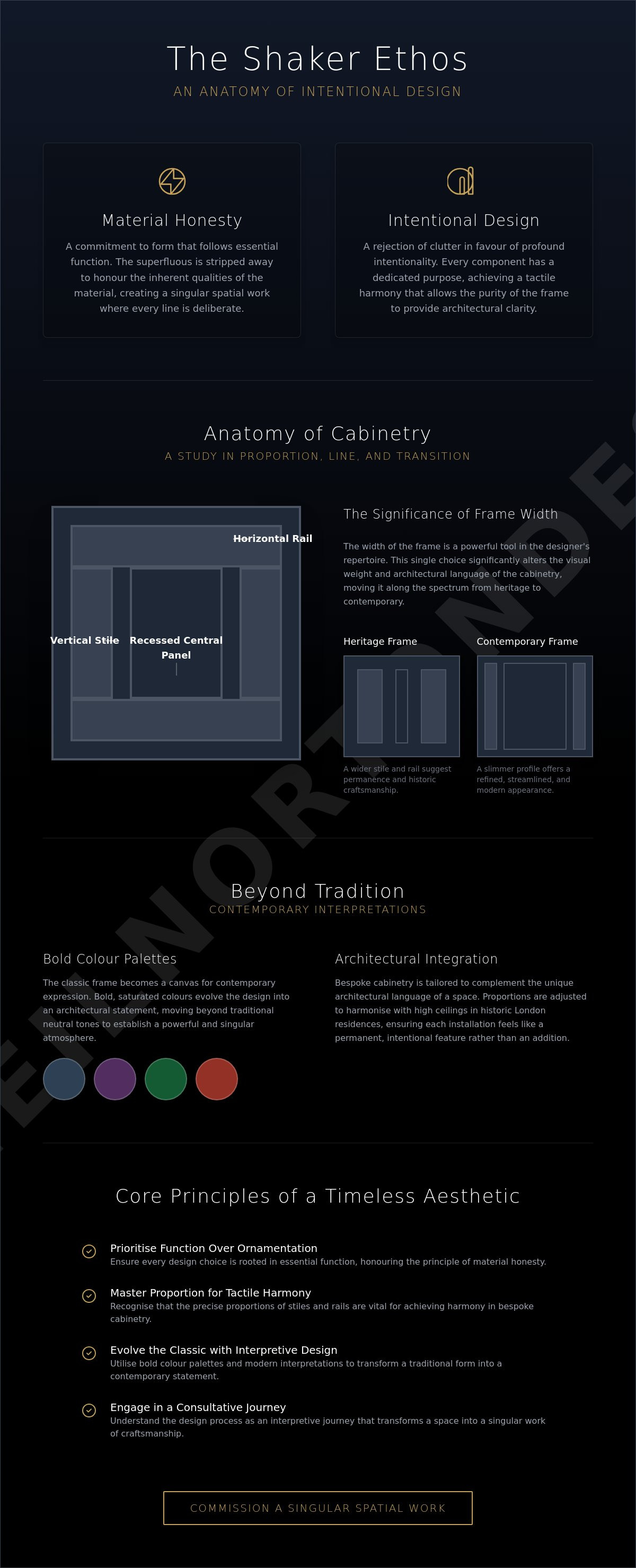
The structural integrity of the shaker style is rooted in its geometric precision. Every component serves a purpose, contributing to a cohesive whole that transcends simple utility. At the heart of this design is the classic five-piece door. This assembly consists of vertical stiles and horizontal rails that frame a recessed central panel. Unlike mass-produced alternatives, bespoke construction ensures that these proportions are meticulously calculated to suit the specific scale of a room. This rigorous approach is a direct descendant of the broader Shaker style of architecture, where the external clarity of a building was mirrored in its internal fixtures.
Tactile harmony is achieved through the intentional selection of timber and finish. Whether opting for the visible grain of solid oak or the smooth, matte surface of a hand-painted unit, the materiality must align with the intended atmosphere of the home. The junction where cabinetry meets the floor or ceiling is perhaps the most critical transition. A flush plinth or a perfectly scribed cornice ensures that the furniture feels like a permanent architectural feature rather than a temporary addition. These deliberate lines create a sense of order and calm, especially in busy culinary spaces where visual noise can often become overwhelming.
Mastering the Stile and Rail
The width of the frame is a powerful tool in the designer's repertoire. A wider rail suggests a sense of heritage and permanence, whilst a slimmer profile offers a more contemporary, streamlined appearance. This choice significantly alters the visual weight of the cabinetry. In the pursuit of refined detail, the joinery remains invisible, yet its strength is felt in every movement of the door. Choosing between rich walnut or soft, neutral tones is an interpretive process that defines the room's character. For those seeking a truly tailored environment, exploring a bespoke kitchen allows for these proportions to be adjusted with millimetre precision.
Internal Hardware and Tactile Experience
Beyond the external frame, the sensory experience of a space is defined by its hardware and internal junctions. The traditional peg rail, once a staple of communal Shaker life, has been reimagined for modern spatial organisation. It provides a functional yet elegant solution for hanging essentials, maintaining the rejection of clutter. Handles and pulls must complement the architectural language of the door. They should feel substantial to the touch, reinforcing the promise of quality. Internally, the dovetail joint remains the ultimate hallmark of craftsmanship. It is a deliberate choice that signals a commitment to durability, ensuring that the furniture not only looks exceptional but functions flawlessly for a lifetime.
Beyond Tradition: Contemporary Interpretations and Sensory Harmony
Whilst the origins of the shaker style are steeped in 18th-century utility, its modern application is deeply interpretive. It has moved far beyond the rustic "farmhouse" tropes often found in mass-market catalogues. Today, we treat the Shaker frame as a versatile canvas for contemporary expression. By introducing bold colour palettes, such as deep forest greens or moody charcoals, a classic unit is transformed into a striking architectural statement. These choices aren't merely aesthetic; they're designed to evoke a specific emotional response within the home.
The sensory experience of a space is heavily influenced by its finish. A hand-painted surface offers a depth and texture that factory-applied coatings simply cannot replicate. It creates a soft, tactile harmony that invites interaction and reflects light with a subtle, organic quality. When we integrate glass inserts or deliberate material junctions, we add layers of visual variety. These elements break up the uniformity of cabinetry, allowing the eye to rest on the interplay between light and shadow. This focus on sensory harmony ensures that the kitchen transcends its functional role to become a true expression of authorship.
The Evolution of the Handleless Shaker
Removing traditional hardware creates a minimalist architectural language that is particularly effective in modern urban flats. This presents a technical challenge: how to maintain material honesty without the visual anchor of a handle. We achieve this through integrated finger pulls or push-to-open mechanisms that respect the purity of the frame. It's a delicate balance. We must ensure that the sleek requirements of contemporary living don't compromise the tactile experience. Every touchpoint must feel intentional and substantial, reminding the user of the craftsmanship beneath the surface.
Mixed Materiality in Bespoke Design
Depth in a room is often achieved through the thoughtful combination of different materials. Pairing a natural timber island with painted perimeter cabinetry creates a sophisticated contrast that highlights the beauty of both. We use stone, metal, and wood as components of a cohesive whole, ensuring that no element feels incidental. This approach is particularly effective when designing l shaped kitchens that utilise Shaker principles to maximise spatial flow. By using varied materiality, we define different zones within the room without the need for physical barriers, allowing the pursuit of refined detail to guide the user's journey through the space.
Integrating Shaker Style into the London Residence
London’s architectural landscape is a unique tapestry of Victorian and Georgian heritage. In these historic homes, the shaker style acts as a bridge between the elegance of the past and the functional demands of the present. The inherent simplicity of the frame complements the grandeur of high ceilings and original cornicing without competing for attention. Sash windows provide a natural light source that highlights the material honesty of bespoke cabinetry, allowing the soft textures of hand-painted finishes to reveal their true depth.
Designing for the "London footprint" requires a high degree of design sensitivity. Many properties in the capital feature compact or awkwardly shaped rooms that defy standard furniture systems. By adopting an intentional design approach, we can retrofit bespoke pieces into period alcoves that would otherwise remain underutilised. Every line, joint, and transition must be deliberate. This ensures the new installation feels like a natural extension of the building’s original fabric, turning architectural constraints into opportunities for authorship.
Bespoke Solutions for Period Properties
Uneven walls and sloping floors are common challenges in London's older residences. Shaker wardrobes offer a solution that achieves tactile harmony whilst providing essential storage in master suites. By using fitted furniture, we can respect and enhance original architectural features rather than concealing them. For those living in conservation areas, bespoke design allows for a sympathetic renovation that adheres to local guidelines whilst modernising the interior experience through precision craftsmanship.
From the Kitchen to the Home Office
The architectural language of the Shaker frame shouldn't be confined to the culinary space. We extend this aesthetic into singular spatial works such as the bespoke home office or private library. Designing AV cabinets and libraries with this unified language ensures a cohesive whole across the entire residence. It’s about creating a classic design that lasts a lifetime, where the transition from a professional workspace to a social kitchen feels fluid and considered. If you're ready to elevate your period property, you can book a design consultation with our expert team based in Wimbledon to begin your project.
The Neil Norton Approach: Bespoke Craftsmanship and Intentional Design
At Neil Norton Design, we don't view the creation of a home as the mere application of a system. Instead, we see it as the authorship of a singular spatial work. The shaker style provides the architectural language, but the execution requires a deep understanding of refined detail. Every line and transition is deliberate. This ensures the final result is a masterpiece of material honesty. We believe that nothing is incidental. Every component is selected to contribute to a cohesive whole that transcends simple function to become a reflection of your personal lifestyle. This commitment to quality is what has allowed us to serve over 200 happy clients throughout our history.
Our philosophy is grounded in the belief that luxury is found in the precision of the junction and the honesty of the material. By rejecting mass-produced components, we ensure that your furniture is built to the exact requirements of your architecture. This is particularly important in the diverse residential landscapes of London and Ireland, where every home presents unique spatial challenges. We treat every project not as a transaction, but as a catalyst for lifestyle improvement, aiming to evoke a sense of security and pride in the homeowner through enduring craftsmanship.
The Path to a Singular Spatial Work
The process begins with a professional design consultation, which we treat as an interpretive journey. It's a collaborative dialogue where your vision meets our technical precision. We guide you through the nuances of materiality and proportion, ensuring that every joint and surface serves a specific purpose in the room's composition. This stage is vital for ensuring the conceptual vision is flawless before any manufacturing begins at our workshops. Our award-winning perspective in luxury kitchen design allows us to balance traditional aesthetics with modern functionality. We reject predefined options in favour of a truly bespoke, architectural approach. This focus on the pursuit of refined detail is what distinguishes our work from mass-market alternatives, ensuring your home feels unique and personal.
Transform Your Environment
Moving away from standardised systems allows for a home that truly reflects its inhabitants. When design sensitivity is applied to every room, daily use is quietly elevated. Whether we're creating bespoke wardrobes, a custom home office, or an elegant bar, our goal is to achieve tactile harmony throughout the residence. We invite you to envision a home where the transition between spaces is seamless and intentional, creating an environment that feels both grounded and aspirational. With a strong presence in London and Ireland, we possess the operational scale to handle complex, high-end projects whilst maintaining a deeply personal touch. It's time to transform your environment into something extraordinary that lasts a lifetime. Schedule your professional design consultation with Neil Norton Design today.
Envision Your Singular Spatial Work
The enduring legacy of the shaker style lies in its unique ability to transcend simple function, becoming a masterclass in proportion and material honesty. By embracing a singular spatial work rather than a standardised system, you ensure that every line and transition in your home is deliberate. We've explored how tactile harmony and refined detail can elevate daily use, especially when tailored to the specific architectural language of historic residences. It's about creating a home that feels both grounded and aspirational.
As an award-winning design studio with over 200 bespoke projects completed, we specialise in creating interiors that last a lifetime across London and Ireland. Our interpretive approach ensures your home becomes a true expression of authorship, where nothing is incidental and every junction is considered. It's time to reject predefined options in favour of craftsmanship that respects your vision. Begin your architectural journey with a Neil Norton design consultation to discover how we can transform your environment with precision and care. We look forward to helping you create a space that is truly yours.
Frequently Asked Questions
Is the Shaker style still popular for modern kitchens in 2026?
Yes, the shaker style remains the pre-eminent choice for modern culinary spaces in 2026, accounting for approximately 50% of designs observed at major industry exhibitions. Its dominance is largely due to its adaptability within transitional interiors, which now represent 60% of kitchen designs. This aesthetic provides a stable foundation for evolving trends whilst maintaining a sense of permanence.
How does a bespoke Shaker kitchen differ from a standard modular kitchen?
A bespoke Shaker kitchen represents a singular spatial work where every line and junction is calculated to suit your specific architecture, unlike modular systems that rely on predefined widths. Standard kitchens often compromise on proportion to fit a grid. In contrast, bespoke design allows for an interpretive process where cabinetry is scribed perfectly to uneven walls or high ceilings, ensuring that nothing is incidental.
Can Shaker style be used for bedroom wardrobes and home offices?
Absolutely, the Shaker aesthetic is a versatile architectural language that extends seamlessly into bespoke wardrobes and home offices. By utilising a unified design language across different rooms, you create a cohesive whole that elevates the sensory experience of the entire home. Whether it's an AV cabinet or a private library, the pursuit of refined detail ensures that these functional pieces become expressions of authorship.
What are the best colours for a contemporary Shaker-style kitchen?
Contemporary interpretations of the shaker style currently favour moody, jewel-toned palettes such as deep forest greens, navy blues, and matte charcoal. Research from 2026 indicates that over 52% of new kitchens feature a two-tone scheme, often pairing these darker hues with warm natural wood grains or creamy neutrals. These choices add a layer of intellectual depth to the room, moving away from the stark whites of previous decades.
How do you choose the right handles for Shaker-style cabinetry?
Choosing the right hardware requires a focus on tactile harmony and the broader architectural language of the door. Whilst minimalist trends lean towards push-latches and integrated pulls for a "slim" Shaker look, traditional handles in aged brass or blackened steel provide a substantial touchpoint. The handle shouldn't feel like an afterthought; it must be a deliberate component of the door's overall proportion.
What is the most durable material for a bespoke Shaker door?
Solid timber, such as oak or walnut, remains the most durable and honest material for a bespoke Shaker door. These materials offer a tactile quality and structural integrity that lasts a lifetime, unlike mass-produced composites. When finished with hand-applied paints or oils, the wood grain provides a subtle texture that reflects light beautifully, honouring the principle of material honesty.
Is Shaker style suitable for small London flats with limited space?
Yes, the Shaker aesthetic is exceptionally well-suited to the "London footprint" where maximising utility in compact or awkwardly shaped spaces is essential. Its clean lines and lack of superfluous ornamentation prevent small rooms from feeling cluttered. By employing intentional design, bespoke cabinetry can be retrofitted into period alcoves, transforming a limited floor plan into a highly organised environment.
How does Shaker design contribute to the "material honesty" of a room?
Shaker design embodies material honesty by ensuring that the form of every component follows its essential function without the distraction of decorative whimsy. It treats the wood as a work of art in its own right, where every joint and transition is visible and deliberate. This transparency of construction ensures that the environment transcends simple utility to become a sanctuary of order and clarity.


Comments