Alcove shelving: Bespoke price levels and client case studies

Alcove shelving (architectural joinery) transforms underutilised wall recesses into precise, tailored storage. Mass-market timber boards can cover a basic need, yet custom integration brings structural integrity and material honesty to period properties. Your commission still needs tailored planning for uneven Victorian walls and the weight you intend to place on each run.
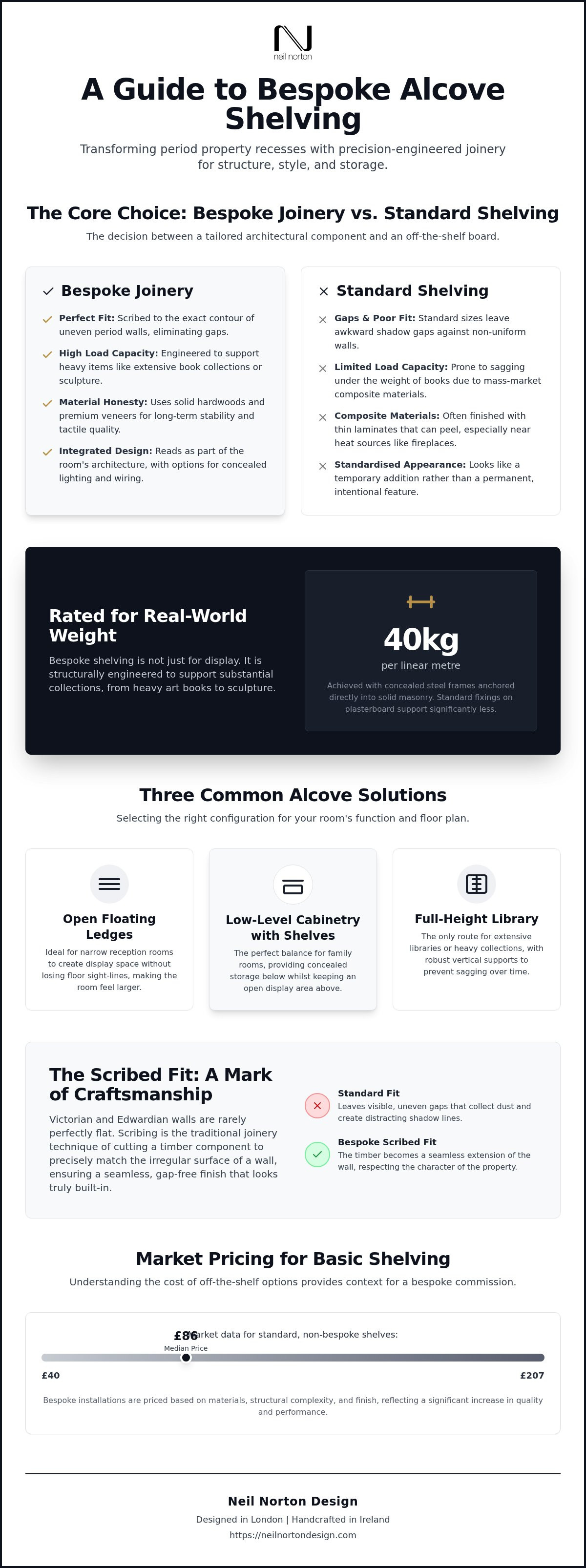
Key Takeaways: Bespoke alcove shelving supports up to 40kg per linear metre when anchored into masonry using concealed steel frames and scribed timber for uneven walls.
Market prices for basic shelves range from £40 to £207 with a £86 median.
Except when installing on hollow plasterboard which requires specialized toggle anchors or stud backing.
Choose solid hardwood or reinforced veneers for heavy libraries to prevent long-term timber sagging.
Custom installations include a long-term warranty covering both structural integrity and hardware performance.
The choice in front of you is practical: will a standard board sit acceptably in the recess, or do you need joinery scribed to the plaster, rated for real loads, and finished so it reads as part of the room? Weight limits, timber, installation method, price and lead time are the decision points the sections below set out in order.
Table of contents
Floating ledges or built-in cupboards: pick the setup your room needs
Bespoke alcove shelving turns asymmetrical recesses into balanced focal points. Standard depths often leave the full spatial potential of a period nook unused. Measuring wall tolerances so each timber run sits flush, without awkward shadow gaps, is where the work begins.
Three situations come up again and again:
You have a narrow reception room and want display without losing floor sight-lines: open floating ledges keep the floor visible and suit the tighter plan.
You need real storage under the display in a family living room: low-level cabinetry (bespoke built‑in wardrobes) anchors the lower wall while shelves run above.
You are housing an extensive library or heavy objects: full-height timber with proper structural support is the route that matches the load.
Your choice between floating ledges and integrated built-in cupboards also dictates how light moves across the chimney breast. Open floating designs preserve floor visibility. Low-level cabinetry gives substantial storage and a grounded lower half.
Framed wall recesses have long served as dedicated displays for treasured objects. Subtle lower lighting can highlight the pieces you place there and bring material honesty out of the timber grain. Integrated channels hide wires (hidden engineering) behind solid facings so the composition stays clean.
Floating ledges suit minimal accent displays; full-height runs suit libraries. Natural oak or hand-painted finishes keep tactile harmony with existing architectural moulding. You can refine the brief through our alcove shelving guide and consultation options. Nothing is incidental in the detailing.
Solid shelves rated for heavy books and sculpture
Solid alcove shelving supports heavy art books or stone objects when the fixings bite into solid masonry. Solid brick holds far more mass than a hollow plasterboard partition.
Custom floating timber shelves carry up to forty kilograms per linear metre when correctly installed. Standard floating brackets on stud walls support significantly less weight.
To reach that load capacity, the workshop integrates concealed steel framework into the wall structure. Solid oak or walnut slabs flex far less than thin veneered boards under weight. Each structural junction receives precise mechanical anchorings.
For extensive libraries or heavy sculpture, specify thick hardwood profiles with recessed steel supports. Lighter decorative displays suit thinner timber boards on subtle lateral batten cleats. You can review floating installations in period London properties through our custom work. More on this: Bespoke Kitchens & Furniture London.
Typical market prices for custom alcove installations span a broad range by material and structural complexity, based on current industry data. The final cost reflects timber selection, structural wall preparation, and integrated architectural lighting. Weight limits depend directly on the fixings.
Clients often worry about long spans. Integrated vertical dividers are designed in to limit timber sagging over time, so the storage stays true for decades.
Tip: Assess your wall substrates before specifying heavy solid timber or books, as fixings into plasterboard require specialised toggle anchors or structural stud backing.
Among the studio’s Google reviews, Michelle (5★) wrote:
"Lovely jubbly kitchen that really has the wow factor. Great prices and very good lead times. Will be adding pictures to my review shortly."
She was weighing price and programme as much as appearance; the same structural care that delivered her kitchen finish is what lets bespoke shelving carry real weight without the surface giving way.
Solid timber and veneers built for period recesses
You are choosing between standard materials and bespoke alcove shelving for a period recess. Components are crafted in the studio’s own workshop in Ireland to the standard luxury residential interiors demand. Material selection dictates how long the run will last.
Heavy books make standard composite boards sag over short spans, while engineered solid timber holds its line without visible supports. Dense hardwoods or reinforced oak veneers give the strength wider alcoves need.
Material honesty means resolving every joint with intent. Thin laminates often peel near chimneys; solid timber copes better with heat fluctuation. Off-the-shelf units behave like temporary patches on complex architectural gaps. Bespoke work reads as tailored architecture, closing uneven plaster cleanly.
To talk through your layout, get in touch and begin the project conversation. More on this: Contact Neil Norton Design.
Scribed fitting that closes gaps on uneven masonry
Installing alcove shelving asks for exact scribe lines, laser levelling, and concealed wall supports so high structural loads stay clean.
Period masonry alcoves are rarely square. Laser tracking keeps each shelf in true alignment with the room.
Map the masonry: Installers measure wall deviations across multiple reference points.
Mount concealed brackets: Heavy-duty supports anchor directly into the structural substrate.
Scribe the timber: Each shelf edge is scribed to mirror uneven plaster profiles.
Secure and integrate: Built-in cupboards receive final shelf alignments alongside hidden wires.
In client projects, homeowners arrived with standard storage units that left unsightly gaps in Victorian alcoves or warped after a season. Tailored joinery was fitted to reclaim the recess from floor to ceiling, producing a refined finish that respects the period fabric and removes the awkward visual gaps for good.
Structural integrity and hardware performance are protected by the comprehensive long-term warranty included with custom installations.
Book a design consultation when you are ready to start the measured survey.
What you pay per shelf and how long the craft takes
Bespoke alcove shelving costs track material quality, architectural complexity, and the dimensions of your room rather than a uniform mass-production tariff.
Mass-market options trade away material quality and leave visible gaps in period recesses. Custom joinery removes that wasted space. London properties with high-quality built-in storage consistently command higher offer prices because buyers recognise the craftsmanship and the absence of dead corners. Off-the-shelf lines arrive quickly; tailored woodwork follows a dedicated workshop schedule so tolerances stay exact.
Prioritising a short lead time over a custom fit often means replacing the work early. Quick fixes sit poorly in period homes. Precision joinery needs patience for true alignment: handcrafted shelves allow full material honesty without forcing standard components into uneven Victorian alcoves. The cost per linear metre reflects that deliberate, hand-finished approach rather than factory throughput. You gain architectural proportions drawn for your walls.
Your investment turns on whether you value speed or permanence. Off-the-shelf shelves suit temporary fixes. Bespoke joinery suits homeowners who want lasting architectural value.
On projects featured in publications such as Architectural Digest, the studio manages each stage from concept to installation. Overall price depends on your timber, finish, and structural specification. Request a personalised quote when you have sketch dimensions and a sense of the load the shelves must carry.
When a standard bookcase still serves you better
Mass-produced units suit temporary spaces or quick updates where a precise architectural fit is not required.
Standard bookcases work well in rented properties or for brief display needs. Period alcoves in London homes, though, rarely present straight walls. Straight timber forced into uneven masonry leaves awkward gaps.
Standard depths also rarely align with surrounding chimney breasts, so floor space is lost in front of the breast. Bespoke alcove shelving treats each recess as a deliberate composition. Designers draw the piece in Wimbledon; craftsmen then build the commission in the west coast of Ireland workshop, keeping material honesty and exact proportion in view.
If you want that level of fit, view the editorial features in Living Etc or book a free design consultation at the Wimbledon showroom. More on this: Press Coverage.
Frequently asked questions
How much weight can the alcove shelves hold?
Weight capacity depends on the fixing method and substrate. Bespoke alcove shelving built from solid hardwoods supports heavy art books when anchored correctly. Market research places basic alcove shelf prices between £40 and £207; structural integrity across those listings still varies widely. Custom installations are backed by a comprehensive long-term warranty covering structural integrity and hardware performance.
What are the alcove shelves made of?
Shelving is crafted from premium solid timbers and natural wood veneers, chosen for strength and material honesty. Pieces come from the studio’s own workshop in Ireland, so each component meets the standard set for the project. The focus stays on tailored proportion and intentional design rather than mass production.
How are the alcove shelves installed?
In-house fitting teams secure the shelving into the wall structure with concealed floating supports or integrated cabinetry frames. The full installation process is managed on site so junctions stay precise, without visible fixings or ugly gaps. Each project is designed in the London studio to the contours of your room.
Should I mount to the wall studs if installing on plasterboard?
You must anchor primary fixings directly into timber studs or solid masonry for long-term load stability. Plasterboard alone cannot reliably carry heavy joinery, so floating shelves need hidden engineering anchored into structural wall points. Fixings into structural timber are what prevent sagging over time.
How long does a bespoke alcove project usually take?
Lead time follows the workshop schedule, the timber you specify, and the amount of structural preparation the wall needs. Off-the-shelf units arrive faster; scribed, hand-finished runs take longer because each edge is fitted to the plaster. A design consultation settles a realistic programme once the recess has been measured.
Your Project in 2026
Bespoke alcove shelving turns period recesses into deliberate design statements. You have seen where floating ledges make sense, where built-in cupboards earn their place, how far solid timber can be loaded, what the market band looks like, and when a standard bookcase is still the honest answer. Designed in the Wimbledon studio and crafted in the Irish workshop, Neil Norton Design supplies custom furniture tailored to your London property.
The work has been recognised in Living Etc, with material honesty held as a constant. Each piece carries the comprehensive long-term warranty and in-house workshop provenance. The team guides you through the design detail until the recess reads as part of the architecture.
To discuss your project in 2026, book a design consultation or visit the Wimbledon showroom at 167 Arthur Road.


Comments