A 2026 Guide on How to Choose a Kitchen Worktop Material

Knowing how to choose a kitchen worktop material means weighing durability against the maintenance you will accept day to day. The total cost of a surface depends on fabrication complexity and structural weight, which you can explore by requesting a personalised quote. Your ideal surface emerges once you evaluate how you cook and how the stone will anchor your space.
Key Takeaways: Choose your kitchen worktop material by balancing your tolerance for maintenance against cooking habits, as durability ranges from porous natural stone to non-porous engineered quartz.
Standard surface materials typically cost £100–400 per linear metre according to 2026 market research.
Select engineered quartz for high-traffic family kitchens to ensure stain resistance without constant upkeep.
Heavy stone slabs require reinforced cabinetry and floor joists to prevent structural sagging or cracking.
The 2026 client-side review of 10 samples confirms premium worktops represent a mid-tier investment.
Table of contents
Three common renovation profiles help determine the right fit
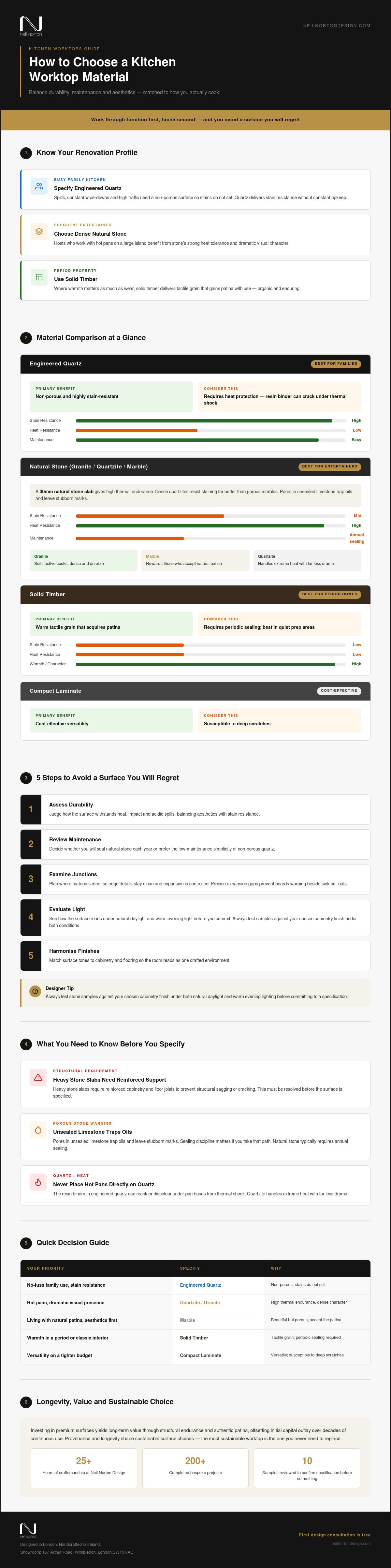
Your functional priorities determine whether high-performance natural stone, engineered quartz, or solid timber best serves your home. Spatial demands shift between active family life, frequent entertaining, and architectural preservation, and each profile points to a different surface.
Busy family cooking, spills and constant wipe-downs: specify non-porous engineered quartz so stains do not set.
Hosts who work with hot pans on a large island: favour dense natural stone with strong heat tolerance and clear visual character.
Period rooms where warmth matters as much as wear: use solid timber for tactile grain that gains patina with use.
Investing in premium surfaces yields long-term value through structural endurance and authentic patina, offsetting initial capital outlay over decades of continuous use. High-traffic culinary spaces need non-porous resilience; dedicated hosts often want heat resistance beside dramatic character on a sweeping island.
When you plan the wider room, align the surface with the architectural composition. Commissioning bespoke kitchens in London keeps each material junction in visual harmony with tactile durability. High-grade stone serves ambitious home chefs; architectural quartz suits busy households; rich timber brings organic warmth to classic period homes. Judge how the surface will age before you lock the specification.
5 Steps that stop you choosing a surface you will regret
Work through function first, finish second, and you avoid stone that marks within a season. Client projects show that reading daily use early prevents premature wear on sensitive stone; choosing on appearance alone is what usually disappoints.
Assess durability: Judge how the surface withstands heat, impact and acidic spills, balancing aesthetics with stain resistance.
Review maintenance: Decide whether you will seal natural stone each year or prefer non-porous quartz.
Examine junctions: Plan where materials meet so edge details stay clean and expansion is controlled.
Evaluate light: See how the surface reads under natural daylight and warm evening light before you commit.
Harmonise finishes: Match surface tones to cabinetry and flooring so the room reads as one crafted environment.
Quartz suits busy families who want low maintenance. Marble fits design enthusiasts who accept a natural patina.
For denser guidance on detailing, read our note on architectural worktop design. Visit the London studio when you are ready to test samples against your joinery.
Tip: Always test stone samples against your chosen cabinetry finish under both natural daylight and warm evening lighting.
Quartz, timber or laminate: match the material to how you cook
Your choice between quartz, solid timber and high-pressure laminate hangs on how your cooking habits balance maintenance against aesthetic longevity. Natural surfaces ask you to accept the way they age; engineered stone gives strong stain resistance and a hygienic prep face for daily meals.
The physical join where materials meet needs precise expansion gaps so boards do not warp beside sink cut-outs. You can open the materials guide for joinery to see how contrasting textures refine bespoke work. Solid timber suits quiet prep areas; engineered stone fits high-impact zones. Material honesty drives the specification.
Visit the Wimbledon showroom at 167 Arthur Road when you want to compare slabs in person.
Heat and impact: pick surfaces that survive real cooking
A 30mm natural stone slab gives high thermal endurance and simpler daily care. Years of crafting bespoke joinery show that dense quartzites resist staining far better than porous marbles. Material honesty means choosing a face that matches how you cook, without constant upkeep.
Picture a searing iron skillet set straight on the worktop: resin binder in engineered quartz can crack or discolour under pan bases from thermal shock, whereas quartzite handles extreme heat with far less drama. Pores in unsealed limestone trap oils and leave stubborn marks, so sealing discipline matters if you take that path.
Dense granite suits active cooks; sealed marble rewards anyone willing to live with natural patina. For deeper spatial notes, see the second materials guide. Nothing is incidental in the junctions you leave exposed.
Book a design consultation at the Wimbledon showroom to plan heat zones and slab thickness together.
What you pay: price bands, fitting and structural prep
Heavy stone worktops need concealed subframe reinforcement so their mass sits safely. In the workshop, craftspeople read load dynamics before shaping dense natural granite or quartz, because massive slabs can strain standard base cabinets and invite sagging over time.
Market research puts standard surface materials at £100–400 per linear metre. Separately, a 2026 client-side review of 10 samples from top market listings placed premium worktops in a mid-tier investment band once slab complexity and structural prep are included. Complete material and fitting costs still move with cut-outs, seams and reinforcement, so the quote reflects the build, not a single list price.
Weak cabinet support behaves like a poor foundation: the stone can crack. Timber worktops suit lighter, flexible designs; heavy marble demands reinforced joinery.
To confirm your cabinets can carry the slab you want, arrange a design consultation at the Wimbledon studio or review award-winning projects featured in Living Etc. The London team will walk through load paths with you. More on this: Press Coverage.
When natural stone is a bad choice for your home
Natural stone fails in busy family kitchens where heavy daily use causes irreversible etching and deep staining. Highly porous marbles absorb acidic oils almost at once, and that vulnerability undermines material honesty as the surface ages.
Lemon juice can ruin unsealed marble in under sixty seconds. Sealed faces still need steady, specialist maintenance. For high-use preparation zones, engineered quartz offers stronger day-to-day durability without giving up visual depth. In a London home, each surface detail should earn its place.
Book a design consultation or call into the Wimbledon showroom at 167 Arthur Road to test quartz and stone side by side.
Provenance and longevity shape sustainable surface choices
Sustainable worktops ask you to balance provenance with long-term performance. Pieces are crafted in the studio’s own workshop in Ireland, which keeps standards exacting from slab to install. During an EKBB Magazine feature on Clare and Mike Singer's three-bedroom Victorian flat, custom cabinets were tailored to an uneven ceiling pitch in Farrow & Ball Railings: the sloped lines made installation demanding, yet the finished cabinetry lifted the room’s sense of height. Precise joinery turned a structural irregularity into a calm, continuous plane.
Choose natural stone or sustainably harvested timber when you want true material honesty; solid surfaces that are well detailed last for decades. If you worry that lower-impact materials lack toughness, tailored stone still delivers long service life. To review sustainable options on the floor, visit the Wimbledon showroom or request a consultation. More on this: Contact Neil Norton Design.
Period floors need reinforcement before heavy stone goes in
Victorian floorboards need structural evaluation before they carry heavy granite or quartz. Unreinforced joists flex under dense stone, and historic subfloors settle unevenly over time, so the load path has to be resolved before fabrication.
Standard fixes often leave gaps in Victorian alcoves or rely on materials that warp. On one period project the team specified custom-made wardrobes to reclaim floor space millimetre by millimetre while matching the heritage finish: the tailored run closed structural gaps and corrected alignment across the uneven floor. London properties with well-built storage consistently draw stronger offers because buyers read the craftsmanship and the absence of wasted space.
Custom installations carry a comprehensive long-term warranty on structural integrity and hardware, which protects the way junctions age where materials meet.
A Google review from a client on a complex period renovation put it this way:
"The shop is located quite far from my home but Neil is very talented."
Distance did not block the craft required to settle the structure.
Tip: Ensure period floorboards are fully reinforced before ordering thick quartz or granite slabs to avoid structural deflection over time.
Frequently asked questions
So… what is the best kitchen worktop?
The right worktop depends on how you use the room and on your aesthetic priorities. Natural stone brings singular tactile character; engineered quartz supplies non-porous resilience. The selection still has to sit inside the wider architectural composition of your home.
Which worktop material suits a busy family kitchen?
Quartz is the practical route for a high-demand household. Its engineered structure resists staining and scratching without seasonal sealants, and it holds up under long-term daily use while keeping a consistent face.
What are the maintenance trade-offs of quartz vs wood vs stone?
Quartz needs little beyond simple daily cleaning. Timber wants regular oiling against moisture as it ages. Natural stone sits between them, with periodic sealing to protect porous areas at joins and cut-outs.
Which kitchen worktop material is the most durable?
Engineered quartz and dense granites lead on structural resilience. Quartz takes heavy daily use without chipping or absorbing liquids; natural quartzite brings comparable strength with original veining.
Are quartz worktops worth the cost?
Quartz is a sound long-term outlay where low upkeep and enduring structure matter. Market research frames standard surfaces at £100–400 per linear metre; the 2026 client-side reading of 10 samples from top market listings placed premium worktops in a mid-tier band once fabrication is counted. For a wider joinery brief, see the feature in Living Etc or book time at the Wimbledon showroom. More on this: Press Coverage.
Selecting Your Surface
How you choose a kitchen worktop material still turns on the same questions you opened with: how the surface will age, what maintenance you will keep up, and how the slab anchors the room you cook in. That choice sets the visual weight of the space, and each surface specified should hold beauty beside practical endurance.
Wimbledon designers refine the junctions where materials meet so they align with your wider architectural vision. The team crafts each bespoke element in the west coast of Ireland workshop, backed by a comprehensive long-term warranty, and the work has appeared in publications such as Living Etc.
To talk through your project, book a design consultation or visit the showroom at 167 Arthur Road, Wimbledon.


Comments